
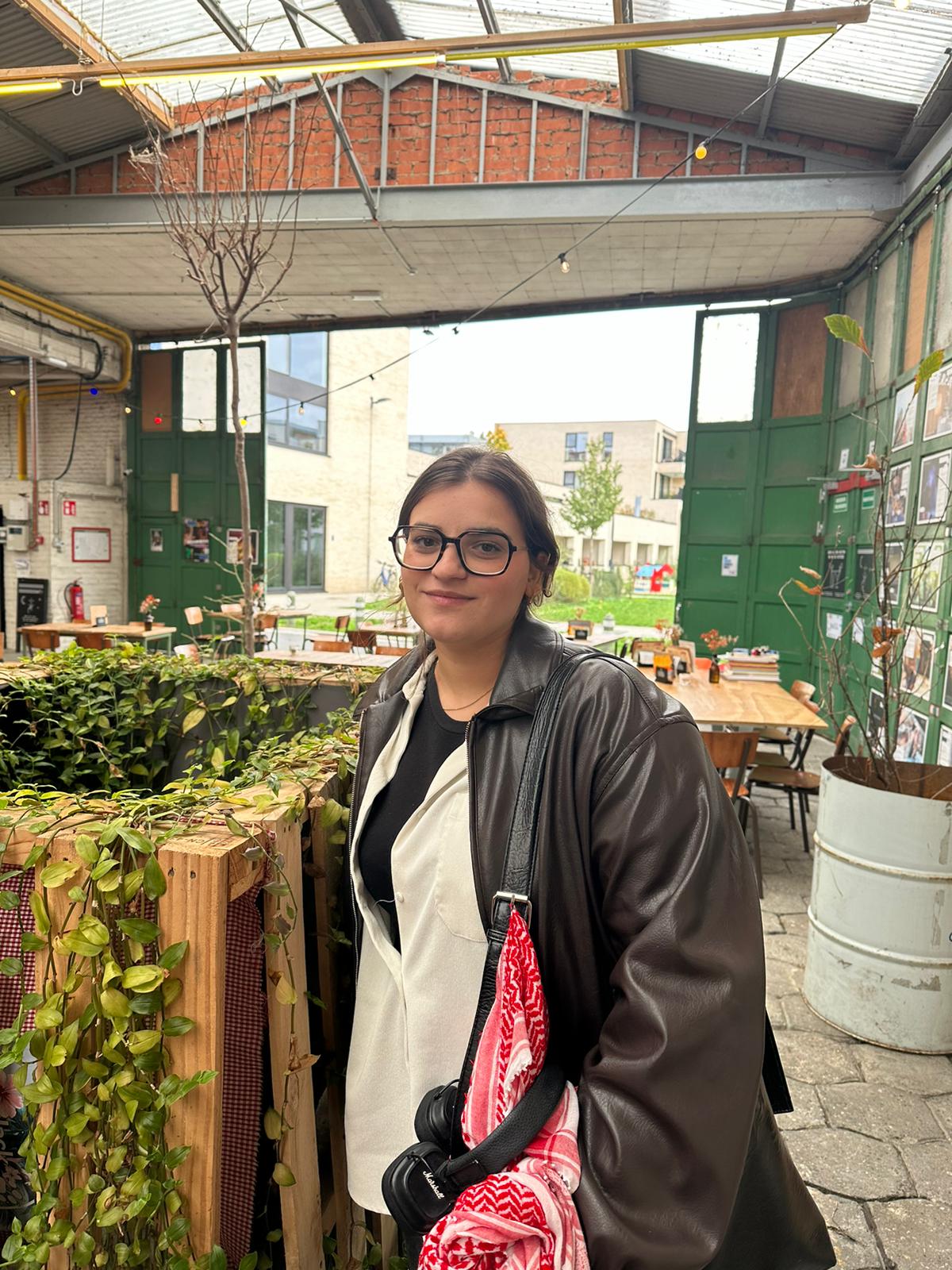
When Reyhan Görgöz grew up as the first Belgian-born child in her Turkish family, she often felt like “the other” at school. “Sometimes it was nice to be different,” she says, “but often it was not nice at all.” In her search for identity, Reyhan encountered not only the boundaries between being Belgian and being Turkish, but also a sense of social distance: “Not only between two cultures, but also between my home environment and middle-class classmates — I felt different on several levels.”
This experience fuelled her social engagement. Reyhan chose to study social work and sociology, partly because she believed that studying and critical reflection should not simply be a personal way out. “Studying was meaningful. Not to passively accept things, but to take action against what feels unjust.”
But Reyhan does not believe in individual struggle alone. It is precisely through collective action and dialogue that spaces of resilience emerge. “I needed people who saw me as a person with abilities, not only as a child with a migration background. Real inclusion begins with recognition and with breaking through polarisation.”
Music connects Reyhan to her roots and turns culture into a bridge between generations. “Turkish cassette tapes used to be our Spotify. We exchanged them while travelling and at home, always searching for that feeling of ‘home’. When I found them again in the attic, it was pure nostalgia. Eventually, I had them included in a museum collection — because migration history is not just an extra story, but a reality that deserves to be visible.”

Polarisation and a Complex Society
Polarisation, she says, emerges where stories are missing. “We say that we live in a superdiverse society, but when you look at the places where people move and meet, they are often still separate worlds.”
As a researcher and lecturer, Reyhan argues for recognition of this complex reality. “Every museum, every institution should dare to acknowledge that a limited story is not necessarily wrong, but it is incomplete. Different stories are never a threat; they enrich our understanding.”
In her work with young people, Reyhan also sees how representation creates enthusiasm and a sense of belonging. “When young people see their own piece of the puzzle reflected in a museum or project, their engagement grows. They discover the importance of their own history — and that gives them autonomy and hope.”
The struggle against polarisation is not only institutional, but also practical. “Social work is never functionally neutral,” Reyhan says. “The professional definition itself states that we fight inequality, exclusion and discrimination. That requires visibility, action and, above all, politicisation.”
For her, politicisation means working together with young people to identify the structural causes behind pain and injustice. “Politicisation can be hopeful, because when you discover that your problem is shared by others, you realise that you are not personally to blame — there are structural problems.”
Young people can then begin to understand that their individual struggle is part of a larger whole. “The most valuable part is searching together: how can we report this, and how can we bring about change?”
Safe spaces are essential for collective care and growth. “A ‘safe space’ is only safe if young people themselves experience it that way, not simply because a researcher has defined it as safe.”
Reyhan sees that young people today do not only want to discuss issues and pain; they also want to develop their own strength and voice. “For a very long time, we have done many things for people. But young people are perfectly capable of telling us, together with us, what works and what they need. That is supportive, but ultimately it also leads to genuine innovation.”

Get Up Stand Up: Politicisation as Care and Activism
In projects such as Get Up Stand Up, this vision becomes tangible. “When young people realise that their problem is shared, and that collective action is possible, hope emerges. Politicisation is not an abstract theory, but a concrete practice of care: working together towards change, not from a position of victimhood, but from a position of strength.”
The process is not easy, however. “Policymakers want quick figures and measurable results, but change among vulnerable groups requires time, patience and deep listening. Polarisation is reinforced when we continue to work through project-based logic and very short timeframes. Trust and collective care are what work in the long term.”
For Reyhan, as a lecturer, this also means challenging future professionals not only to identify problems, but to actively nurture coexistence across differences. “Recognition and representation must be central. Safe spaces have to be actively built, and polarisation is broken down through critical, caring and collective action.”
Her final message is both hopeful and action-oriented:
“Young people are not target groups, but partners. The future of living together across differences depends on the extent to which young people feel that their voice, their pain and their strength are taken seriously. Politicisation is not about dividing people, but about mobilising them and organising hope.”

Would you like to learn more about this approach and how young people can make a difference through collective action? Consult the publication Get Up Stand Up (link) and discover methods and practice-based stories of hopeful resistance — for every young person, professional and policymaker working towards connection and change.

Leave a Reply