
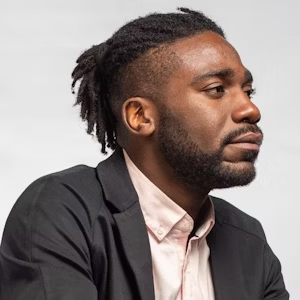
Moussa Don Pandzou is a socio-cultural worker, writer and creator. He works with different communities on decolonisation, racism, discrimination and youth policy. In his practice, he looks for the seeds of projects that strengthen civic participation — and for ways of making “difficult words” accessible to a wider audience.
“Those big concepts need to be translated into everyday language. That is why I write, make reports and take to the stage: to open up the conversation.”
A Love Letter to Belgium — and a Search for Roots
As a boy, Moussa saw Belgium as a possible love. “I wrote Belgium hundreds of letters: see me, accept me.” But growing older brought a new insight: perhaps you are more than someone waiting in the hallway for another person’s approval.

That shift led him towards Congo: the motherland as a place to reconnect and recharge. “To know where you are going, you need to know where you come from.” That sense of rootedness creates stability, like a tree that can only bear fruit when its roots grow deep enough.
WWhat Does It Mean to Be ‘Good Enough’ to Be Belgian?
Moussa examines the implicit script of the ‘good Belgian’: adapt, do not stand out, do not complain, be grateful, and make use of institutions without creating too much friction.
“I have social capital and a vocabulary that can challenge that image. It may feel paradoxical, but it is necessary to create space for other life stories.”
Diaspora and Participation: Recognising What Is Already Happening
The Congolese diaspora in Belgium now includes second and third generations. Within churches and other community spaces, there are intergenerational practices of care and neighbourhood-based initiatives: meeting one another, celebrating together, maintaining shared spaces, and keeping one another informed and organised.
These forms of civic participation often fall outside traditional frameworks such as advisory councils or formal participation processes. Moussa calls for a reframing: when we recognise and professionalise different cultures of participation, policy becomes more closely connected to people’s lived realities.
“See the diaspora as a group with its own needs and its own added value. Recognise the ways in which people organise and act together. Create space where existing institutions are too narrow.”
Moussa refers to research showing that the Congolese community is often described as highly educated, while at the same time facing significant discrimination in the labour market. This makes recognition and access all the more important.
Forgotten Stories: Without the Past, There Is No Direction
Belgium and Congo share an intertwined history. For decades, one narrative dominated: the civilising mission. Today, Moussa — together with many others — calls for a multi-voiced account that also acknowledges pain, domination and loss.
“You can only know where you are going if you know where you are starting from. Schools, leisure organisations and the media: everyone has a role to play.”
Restitution as ‘Repair’: Living Heritage and Kakungu
In the debate around restitution, Moussa prefers the word repair. It is not only about money or objects; it is about relationships.

The example of the Kakungu mask shows that heritage can be alive: for some, it is regarded as an ancestor that was displaced. Some communities do not necessarily want the object itself returned, but instead seek ritual, dialogue, or equal mobility — such as visas and freedom of movement — as part of a process of repair.
“Heritage can be a catalyst. Not to open the Pandora’s box out of fear, but to finally talk together about what would do justice.”
Museums, Policy and Local Context: No One-Size-Fits-All Approach
There is no universal formula. Every local process requires careful exploration, trust, and recognition of lived expertise. Give ownership to the communities involved — bring more Black experts to the table and choose co-creation over simply inviting people to speak. That is how solutions can emerge that previously seemed impossible.
The Belgium–Congo Tension: Whose Concerns Take Priority?
The priorities of the diaspora — racism, access to employment and housing — do not always align with priorities in Congo, such as fighting corruption, poverty, war and health crises. This tension is too often exploited through a divide-and-rule logic: the “European” versus the person who “stayed behind”.
“The effects of colonial narratives still run through our veins. Across the world, the position of Black people has often been precarious. The final question remains: respect Black identity.”

Hopeful Practices: Mushrooms After the Rain
What keeps courage alive? Small, positive practices: a community centre in Molenbeek where white senior citizens and young people from diverse backgrounds support one another; grassroots groups that continue to cultivate care and solidarity, despite political shifts to the right and shrinking opportunities.
“Those mushrooms need to be watered. Then a neighbourhood, a city, a country can flourish.”
A Message to Policymakers, Young People and the Public

We are struggling with hesitation to act: after the wave of momentum in 2020, many people lost their sense of urgency. Moussa’s message is simple: keep showing up.
Policymakers: open up processes, reduce the distance, and share power and decision-making authority.
Young people: know your roots, develop language for your experiences, and organise.
The public: step outside your bubble and enter into conversation; making mistakes is part of the process when you are genuinely willing to listen.

Leave a Reply