
How a Life in Transit Raises Questions
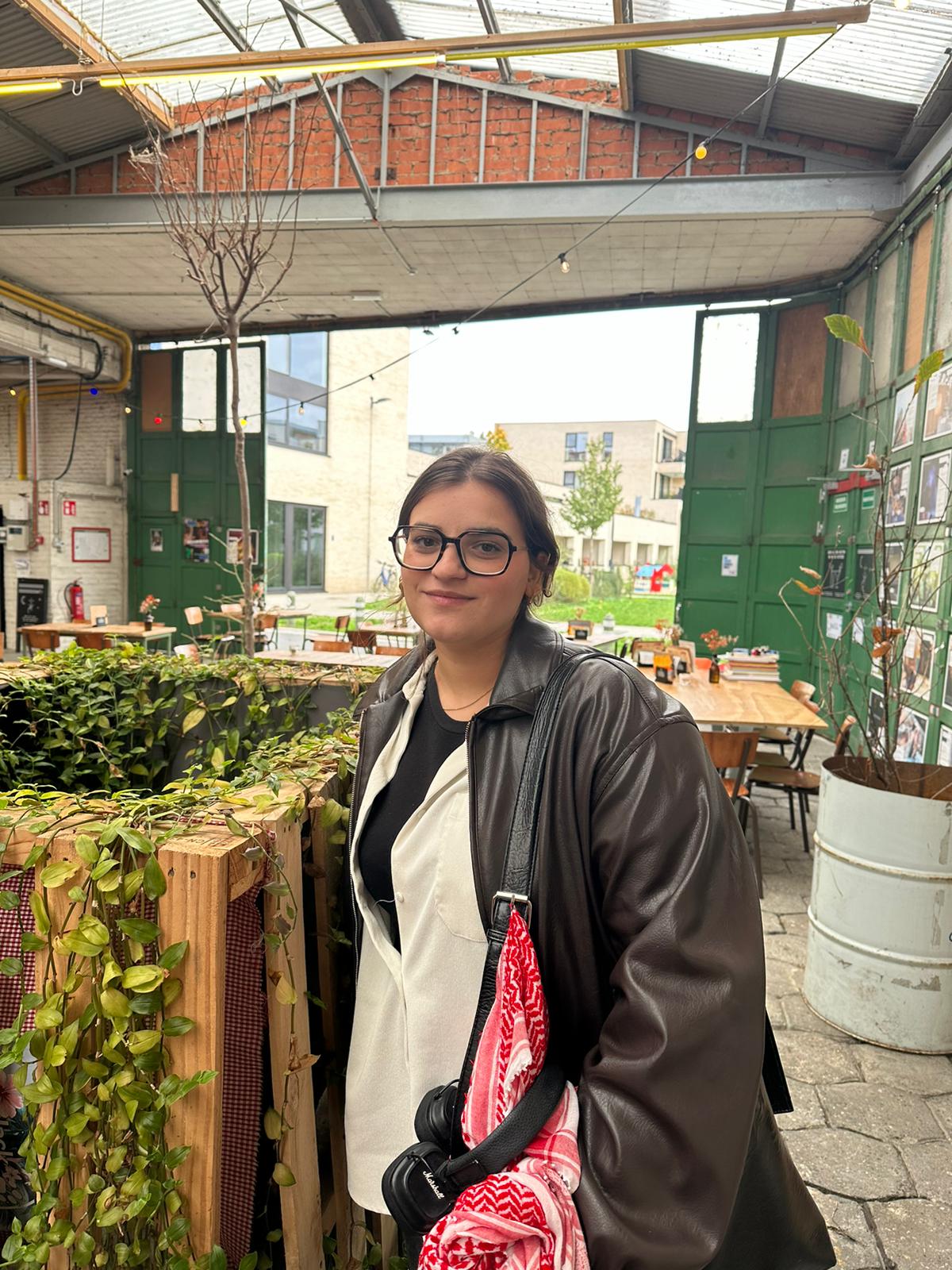
Albina Fetahaj was born in Belgium, three weeks after her parents arrived as refugees from Kosovo. For the first six years of her life, there were no papers and no freedom of movement that could be taken for granted; travelling abroad was impossible.
“It was only when I was six that I could travel to Kosovo for the first time and meet my family,” she recalls.
At the same time, the inequality built into mobility became painfully clear: her relatives could not simply come to Belgium.
“That inequality between passports made me very aware of something: why do borders sustain these kinds of hierarchies?”
For Albina, this is not only about personal experience. During her studies in Political Science and Conflict & Development, she came to understand that behind every migration story lies a system.
“As the child of refugees, you are constantly placed in a position where you have to prove yourself. Your presence is only accepted if you fit the image of the ‘innocent refugee’. But what if you did not flee war, but poverty? The system continuously forces you to justify your existence.”


How Borders Organise Polarisation
Albina noticed that migrants and refugees are repeatedly required to legitimise their presence.
“Your presence is conditional. Even if you were born here, you remain ‘the migrant’.”
This categorisation creates distance: between “us” and “them”, between home and here, between those who are admitted and those who are excluded.
“Polarisation is embedded in laws, policies and symbols of control: who is allowed to stay, who has to leave, and whose absence is noticed.”
Albina’s perspective sharpens when she compares her passports.
“A Belgian passport opens the door to 133 countries, while a Kosovar passport gives access to only a handful.”
Looking at global passport rankings, she sees a broader pattern.
“Mobility is organised globally through hierarchies shaped by class and race. That is not accidental. It is a legacy of colonialism, and today it is still used as a mechanism for maintaining cheap labour and inequality.”
Connection as an Antidote to Walls
Against the isolation and polarisation created by borders, Albina places hopeful stories of connection.
“The diaspora, conversations within families, solidarity with Palestine — all these struggles are connected.”
She describes how undocumented people come together in protest.
“The moment you step outside your assigned category and embrace the collective story, your presence becomes political. We are here because you were there: migration can also be a form of resistance.”

Albina acknowledges that connection is difficult when systems continually diminish people.
“As a migrant, you are expected to expose your trauma, while your presence is never truly secure. But you can discover your own strength once you realise that borders and walls are not natural. They were created by people — and that means people can also dismantle them.”
From Polarisation to Mobilisation: Building New Worlds Together
Through both her writing and activism, Albina focuses not only on analysis, but also on changing perspectives. She sees education as central.
“Policy reproduces inequality, but education gives us tools to question dominant structures.”
Her book Grenskolonialisme (Border Colonialism) invites readers not only to recognise the “violence” of borders, but also to reflect on their own position as either a “border guard or bridge-builder”.
“Everyone is part of the system, consciously or unconsciously. But that is precisely why we can also create a different world together.”
She sees particular strength in young people.
“They are at the forefront. They connect struggles and think beyond the walls that restrict their future. Every protest, every collective action is a building block for a different social order. Polarisation must not stop us — mobilisation creates hope.”
The Future of Connection Beyond Borders
Although Albina recognises that the idea of a world without borders may currently seem unrealistic, she believes change is possible.
“Borders are relatively young. Systems have fallen because of resistance from below. The future is open — our task is to shape it beyond the paradigm of walls and exclusion.”
Her literary and personal journey therefore does not end in fatalism, but in an invitation to collective reflection and action.
“Anyone who thinks about borders automatically begins to think about connection. In my story, and in our stories, lies the potential to break down walls and build places where everyone is allowed to stay, to move and to feel at home.”

Would you like to think further about borders, identity and the legacy of colonialism? Be sure to read Albina Fetahaj’s book Grenskolonialisme (Border Colonialism).

Leave a Reply